Posts

Properties of liquids

Image
In a liquid , the atoms or molecules are free to move randomly within the constraints of the container and the liquid’s surface. As in a solid, the atoms or molecules of a liquid are held together by attractive forces. But these forces are not great enough to hold the atoms or molecules in a fixed pattern; instead, they move about at random. As a result, a liquid can flow and it cannot be stretched or distorted. Like a solid, however, it can be compressed slightly and shows the same sort of elasticity when subjected to compressive stress. Unlike a solid, but like a gas, a liquid exerts pressure, which at any point depends on the depth and the density of the liquid.

Properties of solids

Image
In a pure solid , the atoms are held by electrostatic forces in a regular array in a crystal lattice. This arrangement gives a solid its characteristic properties of strength and hardness. The forces that hold atoms and molecules in place give solids their strength. Interatomic forces are generally stronger than intermolec-ular forces, so that solids composed of collections of single atoms, such as most metals and diamond, are the strongest. Molecular solids, such as plastics, iodine, dry ice (frozen carbon dioxide), and some metals and alloys, are softer and melt more easily.

Crystals

Image
Many substances occur naturally as crystals . Here the yellow crystals of sulfur contrast with the shiny white aggregations of cal-cite (calcium carbonate). Most simple chemical compounds consist of crystals. These cannot always be seen clearly because they are often grouped together in a mass that has no particular shape. But if a lump of crystalline material is examined closely, tiny individual crystals can be seen. All crystals have a definite geometric shape, determined by the way in which the atoms of the substance are linked together. For example, in a crystal of common salt (sodium chloride) the atoms of sodium and chlorine are arranged so that they lie at the corners of a series of (imaginary) cubes; the result is a Cubic crystal.

States of matter

Image
  Atoms in a solid  maintain their regular positions in a crystal lattice and vibrate because of their thermal energy; on being heated, they vibrate more vigorously, causing the solid to expand. In a liquid, the atoms move about randomly; a liquid has no regular form and takes on the shape of its container. In a gas the atoms move rapidly, collisions with the walls of the vessel resulting in gas pressure; a gas totally fills its container. All single substances can, under the right conditions, exist as a solid, liquid, or gas; these are the three common physical states (or phases) of matter.

Into the nucleus

Image
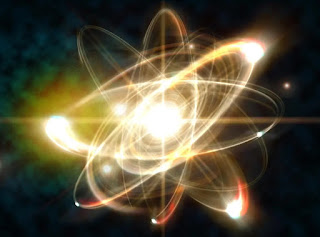
A simple model of the atom visualizes it as having a central nucleus surrounded by orbiting electrons. Near the beginning of the 20th century, the New Zealand scientist Ernest Rutherford carried out one of the most significant experiments in physics. He directed a beam of alpha particles (helium nuclei) at a thin sheet of gold foil. Most of the particles passed straight through, some were deflected slightly from a straight-line path, and a few were scattered through quite large angles. Rutherford deduced that the positively-charged alpha particles were scattered by near collisions with the positively-charged nuclei at the center of the gold atoms. Such scattering techniques are .now central to the study of atomic and subatomic structures. It is now known that every atom contains a nucleus, whose size is about 10,000 times less than that of the atom itself. Most of an atom is empty space. With the exception of hydrogen, every nucleus contains neutrons and protons (colle...

The nature of matter

Image
  Physicists study the properties of matter in the universe and how matter interacts through forces. One way to make these studies is to consider the individual components of matter itself. By studying the microscopic and sub-microscopic constituents of matter, physicists can often deduce how large bits of matter will interact. There can, however, be conceptual difficulties in explaining physics at this sub-microscopic level. The minute particles that make up matter can be “seen” only by the effects they have on visible things, or by the gross phenomena that result when millions of them act together.